

A Pink Pill
Источник: The DairyNews
Traditionally The DairyNews resumes the results of the previous year and gives its own Russian dairy market situation forecast.
But today I would rather give a summary of an epoch as far as peaceful life in all its bearings comes to an end.
In 2014 for the first time since the World War II the International Dairy Federation (IDF) cancelled the World Dairy Summit which was supposed to take place in Israel. The Summit was cancelled because of the war and unstable situation in the region.
In 2014 the Crimea became Russian. This made things difficult. For all.
Finally in 2014 Russia by using a classic judo technique - hip-roll – set the world market up by imposing an embargo on import of dairy products from EU, USA, Canada, Australia and Ukraine. It was an answer to their forbidden trick - a low blow by means of sanctions.
This judo competition has uncovered things which the market participants have been discussing several years: the government policy in the sphere of economic development and agricultural sector in particular is ineffective.
One thing is clear to me (and I guess to the majority of the agricultural market participants): import substitution of agricultural products is impossible neither within a period of three months nor within a year or three years. Even a period of five years is questionable.
Pseudo-dairy unions in Russia
But let’s return to the dairy market.
Regular February-March forums, trade shows and conferences are over. They showed not so much achievements of the Russian dairy front as its downside.
A bright example illustrating this was published by The DairyNews photo made at the trade show Dairy and Meat Industry (Moscow, 17-20 March 2015). The photo lashed the event’s organizers into fury.
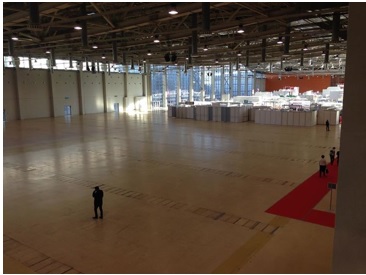
But we didn’t want to offend somebody. We just wanted to display that the industry is almost exhausted: big words and a swarm of empty space.
Two Russian pseudo-dairy unions demonstrated muscles to each other <…>. An amusing observation: communication with the majority of market representatives shows that they are not satisfied with the unions’ work, with empty words and taken decisions (if taken). Are not satisfied but visit the meetings!
May be you come to obstruct them, to boo and to stamp your feet? Then why don’t you do it? Are you afraid?
Meanwhile with the support of our quiet participation people heading these pseudo-dairy unions solve their own problems.
As far as I understand, business – is when you invest money and as a result get returns on sales of products or services. If I invest in milk production I hope to get returns on sales of milk and by-products. Respectively, investing money I need to understand to whom and at what price and volume I will sell my products. Today, tomorrow, the day after tomorrow. I need to understand the market demand and capacity. And I also need to think about the way I plan to make my produce competitive. It means that if my production costs are higher than the competitors’ - I need to understand how to decrease it.
In other words business is based on a business idea. But … let’s keep it real … What is the key point of the business idea for the majority of big projects in dairy farming in Russia? It doesn’t seem to be milk sales or heifers sales.
It is construction. Cattle purchase. Subsidized loans raising. Government support. Ineffective government with its ineffective economic policy generated ineffective business – investors- dependents who do not reckon on their own resources, but earning money with the help of government’s inefficiency.
These ineffective investors using the quiet audience as an argument for their rightness, which comes to “listen to”, ask the officials to allocate more money.
We need to eat less
The main problem of the Russian dairy market today is the demand. Specifically the demand impacts all market participants.
And the demand is decreasing.
Of course not in the official statistics. On paper consumption of dairy products in raw milk equivalent is increasing and reaches 249 kg per person. However according to IDF data in 2013 the consumption in Russia decreased by 7% to 161 kg per capita against 173 kg in 2012.
It is estimated that in 2015 the consumption will not decrease dramatically. There are deterrents for that – inflexibility of the dairy market (the level of consumption is very close to the bottom and has no resources to continue falling) and decrease of people’s ability to pay (dairy products will serve as meat and other expensive protein sources substitutes. Total consumption decrease in 2014-15 is set to reach 15% from 2013 level and to reach 135-140 kg per capita.
A dairy eye-drop or one gram of milk
In 2014 raw milk production in Russia reached 16.2 mln tons what is 2.6% more compared to 2013. However production increase in agricultural enterprises reached 2.2%, in domestic holdings and individual farms – 6%.
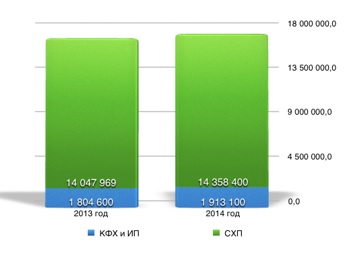
So, annual milk production per capita totaled 111.4 kg or 305 grams a day. Compared to the previous year the final consumer started to get one (!) more gram of milk a day. One gram – is the naked result of all our dairy industry work. A dairy eye-drop!
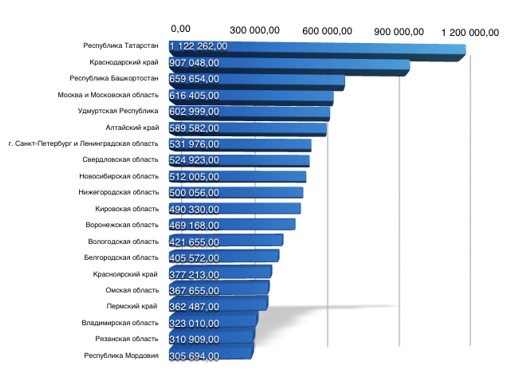
The Republic of Tatarstan, Krasnodar Region, the Republic of Bashkortostan, Moscow and Moscow Region and the Udmurt Republic are the biggest milk producers in Russia.
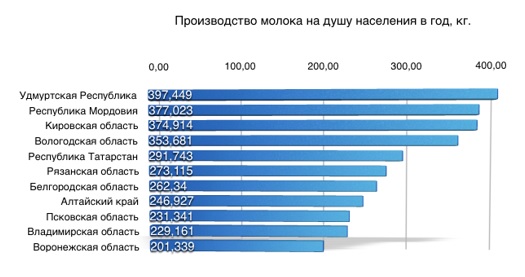
The Udmurt Rpublic, the Republic of Mordovia, Kirov and Vologda Regions produce more milk per local capita than other regions. It’s worth mentioning that the Udmurt Rpublic, the Republic of Mordovia and Kirov Region are comparable in this regard with France, and Vologda Region – with Germany.
At the same time it should be noted that milk production per capita exceeds 200 kg in 68 Russian regions and it is below 100 kg in 42 regions. In 2014 48 Russian regions increased raw milk production, 30 – decreased. The highest level of deficiency is observed in Moscow Region (-2,495 thousand tons), Saint Petersburg (-584 thousand tons) and Rostov Region (-512 thousand tons). Total deficiency in Central Federal District is – 2,304.6 thousand tons.
The southern part of the country is also in a very short supply. The only surplus southern region is Krasnodar Region where in 2014 milk deficiency reached – 32 thousand tons because of population growth. That is to say Russian south including the Crimea has no milk. Total milk deficiency in the Southern and North Caucasian Federal Districts (i.e. Russian south) reached 1,913.6 thousand tons in 2014. Total milk deficiency in the north-west part of Russia reached 713 thousand tons.
The only surplus district in Russia is the Volga Federal District (+396.2 thousand tons) including unfavorable in terms of raw milk base Saratov and Samara Regions.
Processing
Russian milk processing – is the most interesting topic since the most mysterious.
Milk production is one way or the other monitored by Rosstat and Ministry of Agriculture. Milk processing is for some reason covered very formally. This field is as if absent. The Ministry of Agriculture is as if beside the point. Milk processing is also not attractive to the Ministry of Industry and Trade – milk processing is not railway coach manufacturing after all.
That is why Russian Federal State Statistics Service has only general data on volumes of production of some dairy products. Where does the Service take these numbers, how does it generate them, who collects them - is not known.
A regime of import substitution is declared in our country. But we get information only about milk yields. Do we substitute raw milk? Do people consume only raw milk?
A paradoxical situation is created: for example, no one can say how many cheese producers are there in Russia. Recently I was asked to shape a ranking list of cheese producers in Russia. I came to a conclusion that the level of my confidence that the list I made is correct is even not 50%. Producers themselves do not know all of their competitors.
Why does it happen? Because it is not profitable to anybody!
Disclosing this information the government and certain officials risk admitting their inefficiency and false statistics. It is much easier to hide the falsehood beyond tens of thousands of farm producers and private plots than beyond hundreds of processors. Welfare illusion on stores’ shelves – this is the main government’s task: “Electorate! Come to the store! Do you see deficiency? Here is milk, here – cheese, here – butter! We do our best to make you feel pleased!”.
This is not favorable to milk producers. It makes no difference to whom he is selling his milk and what is planned to make out of it. Kefir, cheese, butter, powdered milk … Extra information burdens the producer: but the processor for some reason requires higher quality, higher protein and fat levels.
By the way huge producers – those who are ultramodern, who build complex after complex investing state money, billion after billion – in a word those producers to whom a part of this text above is devoted – they do not need processors at all.
Because they underpay, and milk selling is not their main business. Their main business is building. And governmental support. Their logical scheme is simple: “Do we produce milk? We do. Then support us! Because if we stop producing, nobody will produce. You consider our milk to be very expensive? But look at our beautiful and modern complexes! It is impossible to produce cheap milk at them!”.
It is also not profitable to big monopolists – multinational companies PepsiCo and Danone.
In summer 2014 The DairyNews decided to find out the number of enterprises PepsiCo has in Russia. Only by means of an official enquiry we managed to get the answer – 19 plants in 17 Russian regions.
19? When PepsiCo bought Vimm-Bill-Dann the number of plants was 37! Where are they?
Processing. Statistics
According to Rosstat data, in 2014 in Russia was produced:
5.317 mln tons of liquid milk;
1.083 mln tons of kefir;
116,000 tons of liquid cream;
550,000 tons of sour cream;
148,000 tons of powdered milk and powdered cream;
494,000 tons of cheese and cheese products;
749.000 tons of curd;
251.000 tons of butter;
830 mln STANDARD CANS of condensed dairy products (Listen! Stop messing with our heads with standard cans).
Let us investigate these numbers.
5.3 mln tons of liquid milk – this corresponds to 36.4 liters of milk per capita per year or 100 grams per day.
This is not enough! We are even not in the top-20 in terms of this indicator.
Kefir. In terms of kefir production we are the first in the world! It is so because we are the only one – 7.4 kg per person per year or 20 grams a day.
Cream. 794 grams per capita per year or 2 grams a day.
Sour-cream. Russia annually produces 3.8 kg of this product per capita or 10 grams a day.
Cheese. A very interesting situation here. How much cheese is produced in Russia?
When we compare cheese production in Russia and other countries we make a big mistake. We do not include curd production. In all other countries of the world curd is also cheese. Considering cheese we produce 1.243 mln tons of cheese not 494,000 tons. I suggest that we should count cheese + curd meaning cheese production volumes in Russia. Especially when comparing with other countries.
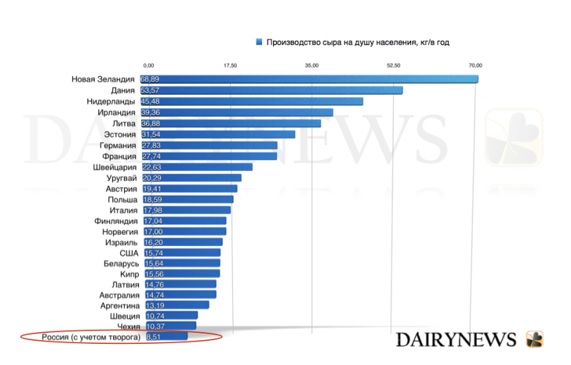
So, Russia produces 8.5 kg of cheese per capita per year or 23 grams a day.
Russia is an unreliable partner
What about the other world? The world is ok.
The other world is really ok. Most importantly is that in the other world almost nobody lies. Russian embargo has definitely disappointed the Europeans. It’s worth mentioning that they WERE disappointed, but eventually got used to it and started solving more important problems.
What is good about Europe? Europe doesn’t change rules of the game. If a decision is taken, it will be executed, because this decision is strategic. European economic policy – is a locomotive – considerable and unavoidable. And on April 1st Europe abolished milk quotas.
EU where milk self-sufficiency reaches 110% increases milk production. Experts forecast milk production in EU to grow 10-15% in the coming years.
What’s the idea of it?
Everything is simple: the world is global. European officials understand that to keep the industry they need to make it more competitive on the international market. There are always foreign players ready to offer a better product at better price. On the dairy market these players are New Zealand, USA, India, Argentina, Brazil, Belorussia, Ukraine (yes, Ukraine!).
A pink pill of government support
Russian government presented the audience the food embargo as a pink pill on a pink diamante pillow: “we saved you, we gave you a chance, look, we are doing our best to make you feel better”.
Does anybody really think it is possible to double cattle population in a year, triple milk yields and suddenly come to self-sufficiency in the dairy sector?
No! This is clear to everybody. This is clear to us, market participants, and the officials. And the majority of people do not understand it as far as they are affected by semiliterate journalists.
Nobody intended to support the agricultural market and the dairy industry in particular. And nobody intends.
You are likely to ask: what about the money allocated within the last 10 years in large quantities?
Declarations! This is the most important! Having at hands huge oil resources the government didn’t manage to manage them carefully. Let us be honest: this money was spent on joys. Within 10 years we’ve bought all cows in the world. And where are they? We’ve spent the money on import seeds, but didn’t get our own. We’ve “holsteinized” cattle and have almost lost our own breeds. We’ve built new dairy farms but can’t receive back the investments.
To make the market work you shouldn’t give it easy money. Just give a possibility to earn the money.
1. The industry needs low interest loans. Don’t subsidize anything. You (the government) have its own bank – Rosselkhozbank. You have oil-dollars. Give me a 2% interest loan so that I could launch my business! No, interest rates subsidizing (read shift the money from one pocket to another) is much more interesting.
2. If I launch a production, don’t levy taxes upon me during 10 years!!! But in a 10 years period I will pay taxes because I will stand on my own legs!!!
3. Gas – is Russia’s property, isn’t it? Why can’t I route it to my production? Help me with gas, electricity and fuel and do not increase prices!!!
4. The same with the mineral fertilizers. Sell them to us!!! You sell them abroad for dollars!!! What will you eat tomorrow? Ok, you live in London, but Russian people live here.
5. Close Federal Service for Consumer Rights and Human Welfare Protection (Rospotrebnadzor)! Exempt us from firefighters and all other controllers!!! They load upon our business! They want illegal gratifications. They are a tool of struggle with undesirable companies. They occur as soon as a business is launched and start threaten, frighten, impose penalties and close businesses.
6. Give us the land! You have it in quantities! We travel over the country and see these useless lands. What for do you need them empty? In 14 years it will be cultivated, in 50 – it will feed you! Though may be not you but your children and grandchildren in case you make them remain here!
7. Create a truthful information collection system. We need very much this information.
And the most important! Stop allocating subsidies!!! They do not work! Time showed that nobody needs this pink pill.
Surplus and waste management
The world agricultural sector history shows: farming industry – is an ability to manage surpluses and waste. The God granted us land, water and sun (money came later). This is enough to start an agricultural business.
Manure enriches the soil and gives energy. Cattle fell is used in footwear production.
Milk surpluses are processed into cheese. Whey is also processed. Everything is of use. This is in an ideal situation. But this ideal state of affairs is still not created in our country.
Cheese production will never be effective unless the whey is processed. Believe it or not, but having a great number of whey purchasers we still import it in great amounts.
A meat cow lives in our shoes and cars’ interior after death. For some unknown reason domestically made cars never have leather interiors and we wear Italian shoes.
Milk surpluses are processed and sold almost to all food industry branches as protein or fat. This is called clustered agricultural economics. This is a remedy. The patient needs this remedy.
This is how the dairy market development program must look: creation of a stable system filled from the inside. Years of hard work are needed to create this system. Work with our own hands.
Pink pills are not able to help us. Let us finally stop swallowing them. Let us put on gumboots and start work. Let us live here. Russia is after all the biggest and the most uncultivated country in the world.
In 2014 for the first time since the World War II the International Dairy Federation (IDF) cancelled the World Dairy Summit which was supposed to take place in Israel. The Summit was cancelled because of the war and unstable situation in the region.
In 2014 the Crimea became Russian. This made things difficult. For all.
Finally in 2014 Russia by using a classic judo technique - hip-roll – set the world market up by imposing an embargo on import of dairy products from EU, USA, Canada, Australia and Ukraine. It was an answer to their forbidden trick - a low blow by means of sanctions.
This judo competition has uncovered things which the market participants have been discussing several years: the government policy in the sphere of economic development and agricultural sector in particular is ineffective.
One thing is clear to me (and I guess to the majority of the agricultural market participants): import substitution of agricultural products is impossible neither within a period of three months nor within a year or three years. Even a period of five years is questionable.
Pseudo-dairy unions in Russia
But let’s return to the dairy market.
Regular February-March forums, trade shows and conferences are over. They showed not so much achievements of the Russian dairy front as its downside.
A bright example illustrating this was published by The DairyNews photo made at the trade show Dairy and Meat Industry (Moscow, 17-20 March 2015). The photo lashed the event’s organizers into fury.
Dairy industry: back view
But we didn’t want to offend somebody. We just wanted to display that the industry is almost exhausted: big words and a swarm of empty space.
Two Russian pseudo-dairy unions demonstrated muscles to each other <…>. An amusing observation: communication with the majority of market representatives shows that they are not satisfied with the unions’ work, with empty words and taken decisions (if taken). Are not satisfied but visit the meetings!
May be you come to obstruct them, to boo and to stamp your feet? Then why don’t you do it? Are you afraid?
Meanwhile with the support of our quiet participation people heading these pseudo-dairy unions solve their own problems.
As far as I understand, business – is when you invest money and as a result get returns on sales of products or services. If I invest in milk production I hope to get returns on sales of milk and by-products. Respectively, investing money I need to understand to whom and at what price and volume I will sell my products. Today, tomorrow, the day after tomorrow. I need to understand the market demand and capacity. And I also need to think about the way I plan to make my produce competitive. It means that if my production costs are higher than the competitors’ - I need to understand how to decrease it.
In other words business is based on a business idea. But … let’s keep it real … What is the key point of the business idea for the majority of big projects in dairy farming in Russia? It doesn’t seem to be milk sales or heifers sales.
It is construction. Cattle purchase. Subsidized loans raising. Government support. Ineffective government with its ineffective economic policy generated ineffective business – investors- dependents who do not reckon on their own resources, but earning money with the help of government’s inefficiency.
These ineffective investors using the quiet audience as an argument for their rightness, which comes to “listen to”, ask the officials to allocate more money.
We need to eat less
The main problem of the Russian dairy market today is the demand. Specifically the demand impacts all market participants.
And the demand is decreasing.
Of course not in the official statistics. On paper consumption of dairy products in raw milk equivalent is increasing and reaches 249 kg per person. However according to IDF data in 2013 the consumption in Russia decreased by 7% to 161 kg per capita against 173 kg in 2012.
It is estimated that in 2015 the consumption will not decrease dramatically. There are deterrents for that – inflexibility of the dairy market (the level of consumption is very close to the bottom and has no resources to continue falling) and decrease of people’s ability to pay (dairy products will serve as meat and other expensive protein sources substitutes. Total consumption decrease in 2014-15 is set to reach 15% from 2013 level and to reach 135-140 kg per capita.
A dairy eye-drop or one gram of milk
In 2014 raw milk production in Russia reached 16.2 mln tons what is 2.6% more compared to 2013. However production increase in agricultural enterprises reached 2.2%, in domestic holdings and individual farms – 6%.
So, annual milk production per capita totaled 111.4 kg or 305 grams a day. Compared to the previous year the final consumer started to get one (!) more gram of milk a day. One gram – is the naked result of all our dairy industry work. A dairy eye-drop!
The Republic of Tatarstan, Krasnodar Region, the Republic of Bashkortostan, Moscow and Moscow Region and the Udmurt Republic are the biggest milk producers in Russia.
The Udmurt Rpublic, the Republic of Mordovia, Kirov and Vologda Regions produce more milk per local capita than other regions. It’s worth mentioning that the Udmurt Rpublic, the Republic of Mordovia and Kirov Region are comparable in this regard with France, and Vologda Region – with Germany.
At the same time it should be noted that milk production per capita exceeds 200 kg in 68 Russian regions and it is below 100 kg in 42 regions. In 2014 48 Russian regions increased raw milk production, 30 – decreased. The highest level of deficiency is observed in Moscow Region (-2,495 thousand tons), Saint Petersburg (-584 thousand tons) and Rostov Region (-512 thousand tons). Total deficiency in Central Federal District is – 2,304.6 thousand tons.
The southern part of the country is also in a very short supply. The only surplus southern region is Krasnodar Region where in 2014 milk deficiency reached – 32 thousand tons because of population growth. That is to say Russian south including the Crimea has no milk. Total milk deficiency in the Southern and North Caucasian Federal Districts (i.e. Russian south) reached 1,913.6 thousand tons in 2014. Total milk deficiency in the north-west part of Russia reached 713 thousand tons.
The only surplus district in Russia is the Volga Federal District (+396.2 thousand tons) including unfavorable in terms of raw milk base Saratov and Samara Regions.
Processing
Russian milk processing – is the most interesting topic since the most mysterious.
Milk production is one way or the other monitored by Rosstat and Ministry of Agriculture. Milk processing is for some reason covered very formally. This field is as if absent. The Ministry of Agriculture is as if beside the point. Milk processing is also not attractive to the Ministry of Industry and Trade – milk processing is not railway coach manufacturing after all.
That is why Russian Federal State Statistics Service has only general data on volumes of production of some dairy products. Where does the Service take these numbers, how does it generate them, who collects them - is not known.
A regime of import substitution is declared in our country. But we get information only about milk yields. Do we substitute raw milk? Do people consume only raw milk?
A paradoxical situation is created: for example, no one can say how many cheese producers are there in Russia. Recently I was asked to shape a ranking list of cheese producers in Russia. I came to a conclusion that the level of my confidence that the list I made is correct is even not 50%. Producers themselves do not know all of their competitors.
Why does it happen? Because it is not profitable to anybody!
Disclosing this information the government and certain officials risk admitting their inefficiency and false statistics. It is much easier to hide the falsehood beyond tens of thousands of farm producers and private plots than beyond hundreds of processors. Welfare illusion on stores’ shelves – this is the main government’s task: “Electorate! Come to the store! Do you see deficiency? Here is milk, here – cheese, here – butter! We do our best to make you feel pleased!”.
This is not favorable to milk producers. It makes no difference to whom he is selling his milk and what is planned to make out of it. Kefir, cheese, butter, powdered milk … Extra information burdens the producer: but the processor for some reason requires higher quality, higher protein and fat levels.
By the way huge producers – those who are ultramodern, who build complex after complex investing state money, billion after billion – in a word those producers to whom a part of this text above is devoted – they do not need processors at all.
Because they underpay, and milk selling is not their main business. Their main business is building. And governmental support. Their logical scheme is simple: “Do we produce milk? We do. Then support us! Because if we stop producing, nobody will produce. You consider our milk to be very expensive? But look at our beautiful and modern complexes! It is impossible to produce cheap milk at them!”.
It is also not profitable to big monopolists – multinational companies PepsiCo and Danone.
In summer 2014 The DairyNews decided to find out the number of enterprises PepsiCo has in Russia. Only by means of an official enquiry we managed to get the answer – 19 plants in 17 Russian regions.
19? When PepsiCo bought Vimm-Bill-Dann the number of plants was 37! Where are they?
Processing. Statistics
According to Rosstat data, in 2014 in Russia was produced:
5.317 mln tons of liquid milk;
1.083 mln tons of kefir;
116,000 tons of liquid cream;
550,000 tons of sour cream;
148,000 tons of powdered milk and powdered cream;
494,000 tons of cheese and cheese products;
749.000 tons of curd;
251.000 tons of butter;
830 mln STANDARD CANS of condensed dairy products (Listen! Stop messing with our heads with standard cans).
Let us investigate these numbers.
5.3 mln tons of liquid milk – this corresponds to 36.4 liters of milk per capita per year or 100 grams per day.
This is not enough! We are even not in the top-20 in terms of this indicator.
Kefir. In terms of kefir production we are the first in the world! It is so because we are the only one – 7.4 kg per person per year or 20 grams a day.
Cream. 794 grams per capita per year or 2 grams a day.
Sour-cream. Russia annually produces 3.8 kg of this product per capita or 10 grams a day.
Cheese. A very interesting situation here. How much cheese is produced in Russia?
When we compare cheese production in Russia and other countries we make a big mistake. We do not include curd production. In all other countries of the world curd is also cheese. Considering cheese we produce 1.243 mln tons of cheese not 494,000 tons. I suggest that we should count cheese + curd meaning cheese production volumes in Russia. Especially when comparing with other countries.
So, Russia produces 8.5 kg of cheese per capita per year or 23 grams a day.
Russia is an unreliable partner
What about the other world? The world is ok.
The other world is really ok. Most importantly is that in the other world almost nobody lies. Russian embargo has definitely disappointed the Europeans. It’s worth mentioning that they WERE disappointed, but eventually got used to it and started solving more important problems.
What is good about Europe? Europe doesn’t change rules of the game. If a decision is taken, it will be executed, because this decision is strategic. European economic policy – is a locomotive – considerable and unavoidable. And on April 1st Europe abolished milk quotas.
EU where milk self-sufficiency reaches 110% increases milk production. Experts forecast milk production in EU to grow 10-15% in the coming years.
What’s the idea of it?
Everything is simple: the world is global. European officials understand that to keep the industry they need to make it more competitive on the international market. There are always foreign players ready to offer a better product at better price. On the dairy market these players are New Zealand, USA, India, Argentina, Brazil, Belorussia, Ukraine (yes, Ukraine!).
A pink pill of government support
Russian government presented the audience the food embargo as a pink pill on a pink diamante pillow: “we saved you, we gave you a chance, look, we are doing our best to make you feel better”.
Does anybody really think it is possible to double cattle population in a year, triple milk yields and suddenly come to self-sufficiency in the dairy sector?
No! This is clear to everybody. This is clear to us, market participants, and the officials. And the majority of people do not understand it as far as they are affected by semiliterate journalists.
Nobody intended to support the agricultural market and the dairy industry in particular. And nobody intends.
You are likely to ask: what about the money allocated within the last 10 years in large quantities?
Declarations! This is the most important! Having at hands huge oil resources the government didn’t manage to manage them carefully. Let us be honest: this money was spent on joys. Within 10 years we’ve bought all cows in the world. And where are they? We’ve spent the money on import seeds, but didn’t get our own. We’ve “holsteinized” cattle and have almost lost our own breeds. We’ve built new dairy farms but can’t receive back the investments.
To make the market work you shouldn’t give it easy money. Just give a possibility to earn the money.
1. The industry needs low interest loans. Don’t subsidize anything. You (the government) have its own bank – Rosselkhozbank. You have oil-dollars. Give me a 2% interest loan so that I could launch my business! No, interest rates subsidizing (read shift the money from one pocket to another) is much more interesting.
2. If I launch a production, don’t levy taxes upon me during 10 years!!! But in a 10 years period I will pay taxes because I will stand on my own legs!!!
3. Gas – is Russia’s property, isn’t it? Why can’t I route it to my production? Help me with gas, electricity and fuel and do not increase prices!!!
4. The same with the mineral fertilizers. Sell them to us!!! You sell them abroad for dollars!!! What will you eat tomorrow? Ok, you live in London, but Russian people live here.
5. Close Federal Service for Consumer Rights and Human Welfare Protection (Rospotrebnadzor)! Exempt us from firefighters and all other controllers!!! They load upon our business! They want illegal gratifications. They are a tool of struggle with undesirable companies. They occur as soon as a business is launched and start threaten, frighten, impose penalties and close businesses.
6. Give us the land! You have it in quantities! We travel over the country and see these useless lands. What for do you need them empty? In 14 years it will be cultivated, in 50 – it will feed you! Though may be not you but your children and grandchildren in case you make them remain here!
7. Create a truthful information collection system. We need very much this information.
And the most important! Stop allocating subsidies!!! They do not work! Time showed that nobody needs this pink pill.
Surplus and waste management
The world agricultural sector history shows: farming industry – is an ability to manage surpluses and waste. The God granted us land, water and sun (money came later). This is enough to start an agricultural business.
Manure enriches the soil and gives energy. Cattle fell is used in footwear production.
Milk surpluses are processed into cheese. Whey is also processed. Everything is of use. This is in an ideal situation. But this ideal state of affairs is still not created in our country.
Cheese production will never be effective unless the whey is processed. Believe it or not, but having a great number of whey purchasers we still import it in great amounts.
A meat cow lives in our shoes and cars’ interior after death. For some unknown reason domestically made cars never have leather interiors and we wear Italian shoes.
Milk surpluses are processed and sold almost to all food industry branches as protein or fat. This is called clustered agricultural economics. This is a remedy. The patient needs this remedy.
This is how the dairy market development program must look: creation of a stable system filled from the inside. Years of hard work are needed to create this system. Work with our own hands.
Pink pills are not able to help us. Let us finally stop swallowing them. Let us put on gumboots and start work. Let us live here. Russia is after all the biggest and the most uncultivated country in the world.
Author: Michael Mishchenko, The DairyNews Chief Editor
Популярные темы
05.06.2026
В России назрела необходимость ввести на официальном уровне рекомендации по питанию. Об этом шла речь на сессии в рамках ПМЭФ-2026 «Особенности национального питания: здоровьесбережение как основа суверенитета».Участники ПМЭФ считают, что если запугать потребителя сладким и жирным, он быстро начнет худеть
Читать полностью
Цитаты дня
