

Mastitis: A universal scourge of the Dairy Industry & why Russian science can help
Источник: The DairyNews
Dairy farmers around the world are overly familiar with the use of antibiotics in their dairy cattle. When new-born calves are removed from their mothers in an intensive agriculture setting and fed milk or reconstituted milk, many of these young calves would otherwise succumb to diarrhoea and die if not given antibiotics. Thus, from an early age, animals are being treated regularly with antibiotics. If cows in the milking herd shows signs of clinical mastitis, their milk is excluded and they are treated with one or more antibiotics. At “Drying-Off”, cows are routinely treated with antibiotics to help manage the levels of mastitis-causing bacteria circulating in the milking herd. At no time, however, is the milking herd as a whole able to be treated for sub-clinical mastitis. This is because of a well-justified interdiction to sell for human consumption milk that contains traces of antibiotics.
An increasing percentage of the Russian milking stock is derived from animals imported from Europe and USA. When introduced to Russia, they brought with them antibiotic-resistant mastitis-causing bacteria that had evolved to resist antibiotics due the excessive use of antibiotics over many decades. Thus today in Russia and around the world, our dairy herds are riddled with antibiotic resistant bacteria that cause havoc and economic loss to milk producers. These same antibiotic-resistant bacteria are becoming more and more difficult to treat as our battery of effective antibiotics is growing smaller over time. Mastitis costs dairy farmers more than $2 billion USD in annual losses around the world. For several reasons, this incidence of mastitis in Russian herds is probably higher than in USA or Europe because we have yet to introduce monthly Centralise Milk Testing (CMT) coupled with Dairy Herd Improvement (DHI ) management techniques that have become common place elsewhere over the last 20 to 30 years (See recent Dairy News article: http://dairynews.ru/news/mastitis-is-your-enemy-when-trying-to-improve-fert.html?sphrase_id=420837
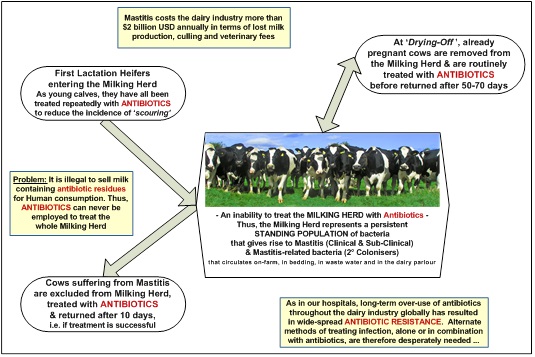
The DiIemma:
Mastitis infections resemble in many ways cancer. To treat mastitis effectively, one needs to diagnose and treat the disease early. This means addressing sub-clinical infection before it develops into a clinically- disabling condition capable of provoking permanent tissue damage. If left untreated, a restricted set of pathogenic species infecting an udder quarter are rapidly followed by secondary colonisers, namely, a wide variety of other bacterial species that take-up residence in the diseased tissue. These secondary colonisers damage tissue further and render all hope of treatment and recovery of organ function more difficult as time progresses. For the dairy farmer, advanced cases of mastitis mean lost milk production from the affected udder quarter for the remainder of the cow’s life and / or the need to cull the animal. Here, the dilemma is that available treatments in the form of antibiotics cannot be deployed on the whole milking herd. In the absence of effective vaccines, this leaves the milking herd permanently infected with different levels of sub-clinical mastitis. Thus, novel treatments are desperately needed for the dairy industry. Until such times, ‘On-farm’ disease transmission will continue to infect fresher cows and imports to the herd. Here, Russian scientific expertise can assist.
I recently reviewed the alarming situation of antibiotic resistance in our hospitals globally and the need to seek-out alternatives to the use of antibiotics, as sought by the World Health Organisation.
The situation is equally alarming and antibiotic resistance is possibly even more prevalent in dairy herds internationally, i.e. than it is in our hospitals and healthcare facilities. This is due to over-use of antibiotics since the end of the Great Patriotic War. The dairy industry as a whole must work to find appropriate solutions. In Russia, we possess an unsurpassed scientific heritage in the use bacteriophage (viruses that literally ‘eat bacteria’, as their name suggests, but that cannot infect the cells of people or cows). This offers novel possibilities for the treatment of bacterial infections, and in particular mastitis.
A clearly-defined objective should be to eradicate mastitis from the Russian dairy herd prior to 2025. Nearer-term, a reduction in the incidence of mastitis in our Russian dairy herds to manageable levels should be made a high priority. By so doing, antibiotics can then be deployed only rarely and only on non-responsive cases of mastitis. Bacteriophage are found naturally in raw milk and persist in every glass of Pasteurised milk ever drunk at levels of around a few billion per millilitre. (This is not the case of UHT or ultra-Pasteurised milk which is sterile and free of living bacteriophage and bacteria). Cheese producers are familiar with the issue of bacteriophage contamination. This can destroy batches of ‘starter’ cultures and as a consequence cause economic loss during cheese manufacture, i.e. due to the bacterial killing ability of bacteriophage.
In the dairy herd, these ‘phage’ assist animals in warding-off bacterial infection, namely, a naturally-occurring remedy that keeps some cows free of mastitis, while others in the adjacent stall succumb to infection. Of interest to the dairy industry is the notion that bacteriophage can be harnessed with something akin to probiotic yogurts that help us digest our food. Importantly, prevention and control of mastitis becomes feasible not just in sick animals, but most importantly in the “Whole Milking Herd”. The latter is currently a cess-pit of infection that the milk producer helps perpetuates due to legal restrictions preventing the sale of milk contaminated with antibiotics. The latter is highly undesirable as this would further increase the levels of antibiotic resistance in humans.
Bacteriophage:
The initial discovery of bacteriophages is attributed to Frederick Twort exactly 100 years ago in 1915 and Felix Herelle in 1917. Herelle went on to demonstrate the efficacy of these novel biological elements in fighting all manner of infection in several settings. This heightened international awareness of their potential to successfully eradicate disease. Most notable of Herelle's exploits was the eradication of an epidemic of Avian Typhoid fever in France. He also studied cholera patients in India. In 1927 over the course of a few months, Herelle was able to reduce the death toll due to cholera from 60% to 8% by inoculating wells with bacteriophage isolated from cholera patients. The origin of the curative properties of the far-from-clean waters of the Ganges River, as sought out by the Hindu faithful, can possibly be attributed to the gradual build-up and abundance in the waters of the Ganges of bacteriophage directed against cholera, and particularly their curative powers against this deadly infection during cholera epidemics. In 1934, Herelle moved to Tbilisi in Georgia to renew acquaintances with Georges Eliava. Together they were responsible for bacteriophage being employed routinely to treat all manner of infections to the former Soviet Union. Outside the former Soviet Union, phages cocktails proved to be less reliable than broad spectrum antibiotics, i.e. once the latter became widely available after the Great Patriot War (WWII). During the War, the Soviet Union used bacteriophages to treat many soldiers infected with various bacterial diseases including dysentery and gangrene. The US pharmaceutical company, Eli Lilly, attempted to commericalise bacteriophage during the 1940s, but this was short-lived and curtailed by the advent of antibiotics. Unfortunately, these same antibiotics have now lost much of their broad-spectrum bacterial killing capacity due to the appearance of antibiotic resistance.
Bacteriophage and Human and Animal Safety:
Bacteriophages are defined, as their name would suggest, as ‘eaters of bacteria’. They bind specific receptors found only on the surface of bacteria; and can therefore not directly infect mammalian or other cell types. Bacteriophages are probably the most common ‘self-replicating entity’ encountered on Earth, even more so than their bacterial hosts. Estimates run to some 1031 particles. Bacteriophages are found throughout our bodies and the surrounding environment and, as such, we eat them daily and play host to multitudes of different bacteriophage within or on our bodies. The safety of bacteriophage is today beyond doubt because of the following important observations:
1) On a daily basis, humans either in our food and drink or on our skin or in our body orifices co-exist with billions and billions of bacteriophages. Naturally-occurring bacteriophage in our bodies are not known to cause detriment. Indeed, bacteriophages are actually beneficial by assisting the body to fight-off infectious agents and / or limit the damage they cause.
2) Bacteriophage are only capable of infecting bacterial cells and not humans or animals cells.
3) Every glass of Pasteurized milk ever sold contains many billions of bacteriophage.
4) Trillions of bacteriophage have been administered to millions of people as part of live organism vaccines around the globe.
a. In the mid-1970’s, this realization lead the US Food and Drug Administration (US FDA) to formally and retrospectively approved the inclusion of bacteriophages of various and unknown kinds in human vaccines.
b. The US FDA subsequently went on to demonstrate that the bacteriophage present in such human vaccines were unlikely to cause harm to humans.
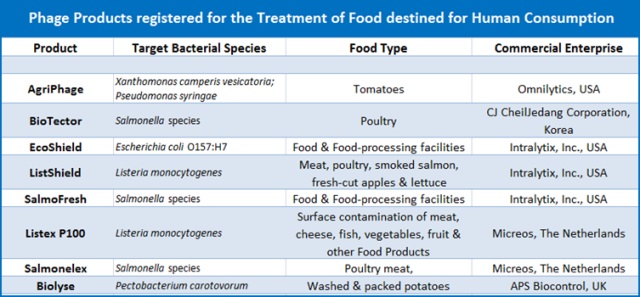
5) Several bacteriophage preparations have been registered for use in the treatment of food items destined for Human consumption (See Table).
6) Bacteriophage are rapidly eliminated from the body at 99% in < 30 minutes), i.e. unless they encounter target bacterial strains, which they then set about destroying.
7) Many thousands of humans were administered bacteriophage to effectively treat all manner of infection in the former Soviet Union, while today the Russian state-owned corporation, MicroGen, continues to sell millions of doses per annum of bacteriophage destined for human use. In 2013, MicroGen sold an estimated 26 million doses and this without widespread reports of detectable deleterious side-effects or a hecatomb in the Russian population.
8) Endotoxins and immunogens are sometimes cited as a potential cause for concern within preparations of bacteriophage destined for administration to humans. However, today, there exist effective methods for the removal of these contaminants from phage preparations. Thus, the same would apply for veterinary applications destined to control mastitis.
The role of genetic testing:
Russian dairy breeders are increasingly familiar with genotyping sperm for inherited disease prior to deployment of sperm lots within their herds for Artificial Insemination (AI). Before one can actually think about developing novel treatments for mastitis, one must first understand the actual cause of disease (Bacterial strains and species infecting Russian dairy herds). Modern molecular techniques and genomics analysis opens doors that were not previously available to veterinary science as concerns the diagnosis and control of mastitis. This field has been revolutionised over the last 4-5 years with the introduction of low-cost high-throughput DNA sequencing technologies. Just a few decades ago, similar analyses cost billions of USD per DNA genome and several years to complete. This is now routine, takes a matter of a few days and is truly low cost. This represents a remarkable turnaround from the delivery of the first human DNA sequence ‘completion’ in 2001. The latter represented the fruits of an international high-cost decade-long endeavour. Today, laboratories in Russia and around the world can complete the same task in a matter of days to weeks and complete this task for a few dozen whole genomes in parallel for little additional cost. A national reference collection of mastitis bacteria could be coupled with DNA sequence information at low cost in order to better understand strain variation, disease genesis, antibiotics resistance in the Russian dairy herd. Here, Russia could feasibly lead the world in this important aspect of dairy science and couple this with efforts to deliver cures for mastitis.
Canadian Example, as concerns understanding Mastitis on a national level:
The Russian winter is world famous for its harshness. Canada shares the same extremes of climate as seen in much of the Russian Federation, yet is further advanced when it comes to addressing mastitis head-on. In 2001, funding became available to establish the Canadian Bovine Mastitis and Milk Quality Research Network (CBMQRN) with a view to providing “the Canadian dairy industry with new tools and knowledge to improve udder health and milk quality, as well as to reduce the significant economic losses due to mastitis”. As part of this initiative, a national reference collection for mastitis-related bacterial came into being. Today, it houses some 17,000 reference bacterial strains and species. Before one sets about controlling or reducing the incidence of mastitis nationally, one must first establish the causality of disease in the local setting. Bacterial populations will vary between individual animals and herds, but on a national scale commonalties allow informed decisions for improved control of this debilitating disease that continues to render milk production less profitable around the world. For further details, please see: http://www.medvet.umontreal.ca/rcrmb/en/page.php?p=30&tm=h&niv=3
Conclusions:
The antibiotics deployed in the dairy industry today show increasing levels of inefficacy due to antibiotic resistance caused by antibiotic over-use. Bacteriophages have a potentially-important role to play in reducing the national and global incidence of mastitis. Research in this direction is being undertaken by many countries around the world, but ‘Know-How’ is most advanced in Russia and some of the ex-Soviet-block countries. The use of ‘phage’ should be focused on reducing the use of antibiotic use to an absolute minimum, i.e. as part of integrated control measures, such as, enhanced on-farm sanitation, attention to dairy parlour procedures, clean bedding, etc. Bacteriophage offer exquisite specificity and efficacy in killing only targeted bacterial strains. Bacteriophage killing is a naturally-occurring process capable of limiting and eliminating bacterial populations and is active in protecting some, but not all cows, in dairy herds today. These same bacteriophage are present in every glass of Pasteurised milk sever drunk by humans, while bacteriophage are the most common life-form on the planet Earth. We ingest billions from multiple sources every day without harm. Their safety is beyond doubt. Bacteriophage killing is achieved through exponential amplification of their number, if and when, they encounter a specific target bacterium. If no such bacteria are encounter, they are rapidly eliminated from the body. In a dairy setting, they can be used for treatment and prevention of disease. The use of bacteriophage has been approved internationally for treatment of foods destined for human consumption, as per above Table.
RECOMMENDATIONS for the eradication of mastitis from the Russian dairy herd:
The Russian Ministry of Agriculture and the Russian dairy industry as a whole should concentrate on:
1) Healthier cows producing higher Volumes of high Quality Milk, as opposed to encouraging more and more cows
2) Nation-wide Education Programs for milk producers and dairy breeders should be introduced to better demonstrate the economic utility on monthly CMT on each cow linked to DHI management strategies; as shown to dramatically and rapidly increase attributes alluded to in 1) above:
a. Of recent times in Poland, Czech Republic and Turkey (> 500 liters per cow per year in < 2 years following introduction of CMT)
b. By way of long-term cost-benefit to milk producers in a Europe, North America and advanced dairy nations of the Southern Sphere.
3) New Legislation and the introduction of appropriate Subsidies designed to encourage (possibly oblige) the adoption of monthly CMT by all Russian milk producers
a. It is important to link CMT and DHI and appropriate control measures
4) Start treating mastitis ‘Knowingly’ (not ‘Blind’, as today)
a. Conduct susceptibility testing in vitro (laboratory-based tests) to assess the bacterial killing ability of different antibiotics (many of which do not work at all due to resistance) and bacteriophage strains, so as to better ensure success in the field nationally and in individual dairy herds
b. Assist farm veterinarians to understand the exact cause of mastitis in their individual herds (‘Treat knowingly’ infections, as we do in a hospital setting) by offering reliable DNA-based and microbiological diagnostic and susceptibility testing services so as to allow them to stop ‘Treating Blind’ and wasting money on one or more antibiotics that have poor efficacy at best
5) Establish a National Reference Collection of mastitis-associated pathogens derived from all regions of the Russian Federation, as per the Canadian experience
a. Have Russia lead by example on an international scale by proceeding further than the Canadians; and thereby make a real difference to Russian Milk Producers and Russian Dairy Breeders currently working to increase dairy production as part of the Government’s policy for Import Replacement Policy by:
i. Undertake molecular genotyping of bacterial pathogen species and strains using advanced high-throughput genetic and DNA sequencing technologies
ii. Encourage dairy farmers to submit samples of their mastitis milk to a central genotyping facility. By helping contribute towards a cure, this can strengthen industry-wide ‘buy-in’ from those most directly affected, namely, our milk producers
6) Couple CMT milk production data (Milk Quality parameters of dams) with that of genetic profiling of bulls to produce higher quality off-spring from the Russian breeding stock
7) Develop ‘ novel’ cures for mastitis based on bacteriophages and Russian ‘Know-How’
a. Ensure that treatments are fully tested and molecularly defined before they are brought to market. Otherwise, these will be of only limited utility and provoke industry resistance.
i. Phage killing and treatment efficacy must first be thoroughly demonstrated in vitro against Russian bacterial strains and species that give rise to Russian mastitis before any field release.
ii. Pre-field-release must also include pharmacokinetics, pharmacodynamics and bioavailability in vivo studies at site of intended action, namely, the cow udder
8) Field deployment of novel treatments that can start to rid the national dairy herd of clinical and sub-clinical mastitis this decade; and thereby limit the use of antibiotics to an absolute minimum.
Cleaner Russian dairy herds free of mastitis will significantly enhance annual milk production (and milk quality) per cow, possibly to the tune of 1-2 tons per animal. Such an increase in milk production would most effectively address the issue of Import Replacement facing the Russian Dairy Industry, while affording an opportunity for the sale Russian cures for mastitis to the rest of the world.
An increasing percentage of the Russian milking stock is derived from animals imported from Europe and USA. When introduced to Russia, they brought with them antibiotic-resistant mastitis-causing bacteria that had evolved to resist antibiotics due the excessive use of antibiotics over many decades. Thus today in Russia and around the world, our dairy herds are riddled with antibiotic resistant bacteria that cause havoc and economic loss to milk producers. These same antibiotic-resistant bacteria are becoming more and more difficult to treat as our battery of effective antibiotics is growing smaller over time. Mastitis costs dairy farmers more than $2 billion USD in annual losses around the world. For several reasons, this incidence of mastitis in Russian herds is probably higher than in USA or Europe because we have yet to introduce monthly Centralise Milk Testing (CMT) coupled with Dairy Herd Improvement (DHI ) management techniques that have become common place elsewhere over the last 20 to 30 years (See recent Dairy News article: http://dairynews.ru/news/mastitis-is-your-enemy-when-trying-to-improve-fert.html?sphrase_id=420837
The DiIemma:
Mastitis infections resemble in many ways cancer. To treat mastitis effectively, one needs to diagnose and treat the disease early. This means addressing sub-clinical infection before it develops into a clinically- disabling condition capable of provoking permanent tissue damage. If left untreated, a restricted set of pathogenic species infecting an udder quarter are rapidly followed by secondary colonisers, namely, a wide variety of other bacterial species that take-up residence in the diseased tissue. These secondary colonisers damage tissue further and render all hope of treatment and recovery of organ function more difficult as time progresses. For the dairy farmer, advanced cases of mastitis mean lost milk production from the affected udder quarter for the remainder of the cow’s life and / or the need to cull the animal. Here, the dilemma is that available treatments in the form of antibiotics cannot be deployed on the whole milking herd. In the absence of effective vaccines, this leaves the milking herd permanently infected with different levels of sub-clinical mastitis. Thus, novel treatments are desperately needed for the dairy industry. Until such times, ‘On-farm’ disease transmission will continue to infect fresher cows and imports to the herd. Here, Russian scientific expertise can assist.
I recently reviewed the alarming situation of antibiotic resistance in our hospitals globally and the need to seek-out alternatives to the use of antibiotics, as sought by the World Health Organisation.
The situation is equally alarming and antibiotic resistance is possibly even more prevalent in dairy herds internationally, i.e. than it is in our hospitals and healthcare facilities. This is due to over-use of antibiotics since the end of the Great Patriotic War. The dairy industry as a whole must work to find appropriate solutions. In Russia, we possess an unsurpassed scientific heritage in the use bacteriophage (viruses that literally ‘eat bacteria’, as their name suggests, but that cannot infect the cells of people or cows). This offers novel possibilities for the treatment of bacterial infections, and in particular mastitis.
A clearly-defined objective should be to eradicate mastitis from the Russian dairy herd prior to 2025. Nearer-term, a reduction in the incidence of mastitis in our Russian dairy herds to manageable levels should be made a high priority. By so doing, antibiotics can then be deployed only rarely and only on non-responsive cases of mastitis. Bacteriophage are found naturally in raw milk and persist in every glass of Pasteurised milk ever drunk at levels of around a few billion per millilitre. (This is not the case of UHT or ultra-Pasteurised milk which is sterile and free of living bacteriophage and bacteria). Cheese producers are familiar with the issue of bacteriophage contamination. This can destroy batches of ‘starter’ cultures and as a consequence cause economic loss during cheese manufacture, i.e. due to the bacterial killing ability of bacteriophage.
In the dairy herd, these ‘phage’ assist animals in warding-off bacterial infection, namely, a naturally-occurring remedy that keeps some cows free of mastitis, while others in the adjacent stall succumb to infection. Of interest to the dairy industry is the notion that bacteriophage can be harnessed with something akin to probiotic yogurts that help us digest our food. Importantly, prevention and control of mastitis becomes feasible not just in sick animals, but most importantly in the “Whole Milking Herd”. The latter is currently a cess-pit of infection that the milk producer helps perpetuates due to legal restrictions preventing the sale of milk contaminated with antibiotics. The latter is highly undesirable as this would further increase the levels of antibiotic resistance in humans.
Bacteriophage:
The initial discovery of bacteriophages is attributed to Frederick Twort exactly 100 years ago in 1915 and Felix Herelle in 1917. Herelle went on to demonstrate the efficacy of these novel biological elements in fighting all manner of infection in several settings. This heightened international awareness of their potential to successfully eradicate disease. Most notable of Herelle's exploits was the eradication of an epidemic of Avian Typhoid fever in France. He also studied cholera patients in India. In 1927 over the course of a few months, Herelle was able to reduce the death toll due to cholera from 60% to 8% by inoculating wells with bacteriophage isolated from cholera patients. The origin of the curative properties of the far-from-clean waters of the Ganges River, as sought out by the Hindu faithful, can possibly be attributed to the gradual build-up and abundance in the waters of the Ganges of bacteriophage directed against cholera, and particularly their curative powers against this deadly infection during cholera epidemics. In 1934, Herelle moved to Tbilisi in Georgia to renew acquaintances with Georges Eliava. Together they were responsible for bacteriophage being employed routinely to treat all manner of infections to the former Soviet Union. Outside the former Soviet Union, phages cocktails proved to be less reliable than broad spectrum antibiotics, i.e. once the latter became widely available after the Great Patriot War (WWII). During the War, the Soviet Union used bacteriophages to treat many soldiers infected with various bacterial diseases including dysentery and gangrene. The US pharmaceutical company, Eli Lilly, attempted to commericalise bacteriophage during the 1940s, but this was short-lived and curtailed by the advent of antibiotics. Unfortunately, these same antibiotics have now lost much of their broad-spectrum bacterial killing capacity due to the appearance of antibiotic resistance.
Bacteriophage and Human and Animal Safety:
Bacteriophages are defined, as their name would suggest, as ‘eaters of bacteria’. They bind specific receptors found only on the surface of bacteria; and can therefore not directly infect mammalian or other cell types. Bacteriophages are probably the most common ‘self-replicating entity’ encountered on Earth, even more so than their bacterial hosts. Estimates run to some 1031 particles. Bacteriophages are found throughout our bodies and the surrounding environment and, as such, we eat them daily and play host to multitudes of different bacteriophage within or on our bodies. The safety of bacteriophage is today beyond doubt because of the following important observations:
1) On a daily basis, humans either in our food and drink or on our skin or in our body orifices co-exist with billions and billions of bacteriophages. Naturally-occurring bacteriophage in our bodies are not known to cause detriment. Indeed, bacteriophages are actually beneficial by assisting the body to fight-off infectious agents and / or limit the damage they cause.
2) Bacteriophage are only capable of infecting bacterial cells and not humans or animals cells.
3) Every glass of Pasteurized milk ever sold contains many billions of bacteriophage.
4) Trillions of bacteriophage have been administered to millions of people as part of live organism vaccines around the globe.
a. In the mid-1970’s, this realization lead the US Food and Drug Administration (US FDA) to formally and retrospectively approved the inclusion of bacteriophages of various and unknown kinds in human vaccines.
b. The US FDA subsequently went on to demonstrate that the bacteriophage present in such human vaccines were unlikely to cause harm to humans.
5) Several bacteriophage preparations have been registered for use in the treatment of food items destined for Human consumption (See Table).
6) Bacteriophage are rapidly eliminated from the body at 99% in < 30 minutes), i.e. unless they encounter target bacterial strains, which they then set about destroying.
7) Many thousands of humans were administered bacteriophage to effectively treat all manner of infection in the former Soviet Union, while today the Russian state-owned corporation, MicroGen, continues to sell millions of doses per annum of bacteriophage destined for human use. In 2013, MicroGen sold an estimated 26 million doses and this without widespread reports of detectable deleterious side-effects or a hecatomb in the Russian population.
8) Endotoxins and immunogens are sometimes cited as a potential cause for concern within preparations of bacteriophage destined for administration to humans. However, today, there exist effective methods for the removal of these contaminants from phage preparations. Thus, the same would apply for veterinary applications destined to control mastitis.
The role of genetic testing:
Russian dairy breeders are increasingly familiar with genotyping sperm for inherited disease prior to deployment of sperm lots within their herds for Artificial Insemination (AI). Before one can actually think about developing novel treatments for mastitis, one must first understand the actual cause of disease (Bacterial strains and species infecting Russian dairy herds). Modern molecular techniques and genomics analysis opens doors that were not previously available to veterinary science as concerns the diagnosis and control of mastitis. This field has been revolutionised over the last 4-5 years with the introduction of low-cost high-throughput DNA sequencing technologies. Just a few decades ago, similar analyses cost billions of USD per DNA genome and several years to complete. This is now routine, takes a matter of a few days and is truly low cost. This represents a remarkable turnaround from the delivery of the first human DNA sequence ‘completion’ in 2001. The latter represented the fruits of an international high-cost decade-long endeavour. Today, laboratories in Russia and around the world can complete the same task in a matter of days to weeks and complete this task for a few dozen whole genomes in parallel for little additional cost. A national reference collection of mastitis bacteria could be coupled with DNA sequence information at low cost in order to better understand strain variation, disease genesis, antibiotics resistance in the Russian dairy herd. Here, Russia could feasibly lead the world in this important aspect of dairy science and couple this with efforts to deliver cures for mastitis.
Canadian Example, as concerns understanding Mastitis on a national level:
The Russian winter is world famous for its harshness. Canada shares the same extremes of climate as seen in much of the Russian Federation, yet is further advanced when it comes to addressing mastitis head-on. In 2001, funding became available to establish the Canadian Bovine Mastitis and Milk Quality Research Network (CBMQRN) with a view to providing “the Canadian dairy industry with new tools and knowledge to improve udder health and milk quality, as well as to reduce the significant economic losses due to mastitis”. As part of this initiative, a national reference collection for mastitis-related bacterial came into being. Today, it houses some 17,000 reference bacterial strains and species. Before one sets about controlling or reducing the incidence of mastitis nationally, one must first establish the causality of disease in the local setting. Bacterial populations will vary between individual animals and herds, but on a national scale commonalties allow informed decisions for improved control of this debilitating disease that continues to render milk production less profitable around the world. For further details, please see: http://www.medvet.umontreal.ca/rcrmb/en/page.php?p=30&tm=h&niv=3
Conclusions:
The antibiotics deployed in the dairy industry today show increasing levels of inefficacy due to antibiotic resistance caused by antibiotic over-use. Bacteriophages have a potentially-important role to play in reducing the national and global incidence of mastitis. Research in this direction is being undertaken by many countries around the world, but ‘Know-How’ is most advanced in Russia and some of the ex-Soviet-block countries. The use of ‘phage’ should be focused on reducing the use of antibiotic use to an absolute minimum, i.e. as part of integrated control measures, such as, enhanced on-farm sanitation, attention to dairy parlour procedures, clean bedding, etc. Bacteriophage offer exquisite specificity and efficacy in killing only targeted bacterial strains. Bacteriophage killing is a naturally-occurring process capable of limiting and eliminating bacterial populations and is active in protecting some, but not all cows, in dairy herds today. These same bacteriophage are present in every glass of Pasteurised milk sever drunk by humans, while bacteriophage are the most common life-form on the planet Earth. We ingest billions from multiple sources every day without harm. Their safety is beyond doubt. Bacteriophage killing is achieved through exponential amplification of their number, if and when, they encounter a specific target bacterium. If no such bacteria are encounter, they are rapidly eliminated from the body. In a dairy setting, they can be used for treatment and prevention of disease. The use of bacteriophage has been approved internationally for treatment of foods destined for human consumption, as per above Table.
RECOMMENDATIONS for the eradication of mastitis from the Russian dairy herd:
The Russian Ministry of Agriculture and the Russian dairy industry as a whole should concentrate on:
1) Healthier cows producing higher Volumes of high Quality Milk, as opposed to encouraging more and more cows
2) Nation-wide Education Programs for milk producers and dairy breeders should be introduced to better demonstrate the economic utility on monthly CMT on each cow linked to DHI management strategies; as shown to dramatically and rapidly increase attributes alluded to in 1) above:
a. Of recent times in Poland, Czech Republic and Turkey (> 500 liters per cow per year in < 2 years following introduction of CMT)
b. By way of long-term cost-benefit to milk producers in a Europe, North America and advanced dairy nations of the Southern Sphere.
3) New Legislation and the introduction of appropriate Subsidies designed to encourage (possibly oblige) the adoption of monthly CMT by all Russian milk producers
a. It is important to link CMT and DHI and appropriate control measures
4) Start treating mastitis ‘Knowingly’ (not ‘Blind’, as today)
a. Conduct susceptibility testing in vitro (laboratory-based tests) to assess the bacterial killing ability of different antibiotics (many of which do not work at all due to resistance) and bacteriophage strains, so as to better ensure success in the field nationally and in individual dairy herds
b. Assist farm veterinarians to understand the exact cause of mastitis in their individual herds (‘Treat knowingly’ infections, as we do in a hospital setting) by offering reliable DNA-based and microbiological diagnostic and susceptibility testing services so as to allow them to stop ‘Treating Blind’ and wasting money on one or more antibiotics that have poor efficacy at best
5) Establish a National Reference Collection of mastitis-associated pathogens derived from all regions of the Russian Federation, as per the Canadian experience
a. Have Russia lead by example on an international scale by proceeding further than the Canadians; and thereby make a real difference to Russian Milk Producers and Russian Dairy Breeders currently working to increase dairy production as part of the Government’s policy for Import Replacement Policy by:
i. Undertake molecular genotyping of bacterial pathogen species and strains using advanced high-throughput genetic and DNA sequencing technologies
ii. Encourage dairy farmers to submit samples of their mastitis milk to a central genotyping facility. By helping contribute towards a cure, this can strengthen industry-wide ‘buy-in’ from those most directly affected, namely, our milk producers
6) Couple CMT milk production data (Milk Quality parameters of dams) with that of genetic profiling of bulls to produce higher quality off-spring from the Russian breeding stock
7) Develop ‘ novel’ cures for mastitis based on bacteriophages and Russian ‘Know-How’
a. Ensure that treatments are fully tested and molecularly defined before they are brought to market. Otherwise, these will be of only limited utility and provoke industry resistance.
i. Phage killing and treatment efficacy must first be thoroughly demonstrated in vitro against Russian bacterial strains and species that give rise to Russian mastitis before any field release.
ii. Pre-field-release must also include pharmacokinetics, pharmacodynamics and bioavailability in vivo studies at site of intended action, namely, the cow udder
8) Field deployment of novel treatments that can start to rid the national dairy herd of clinical and sub-clinical mastitis this decade; and thereby limit the use of antibiotics to an absolute minimum.
Cleaner Russian dairy herds free of mastitis will significantly enhance annual milk production (and milk quality) per cow, possibly to the tune of 1-2 tons per animal. Such an increase in milk production would most effectively address the issue of Import Replacement facing the Russian Dairy Industry, while affording an opportunity for the sale Russian cures for mastitis to the rest of the world.
Популярные темы

05.06.2026
В России назрела необходимость ввести на официальном уровне рекомендации по питанию. Об этом шла речь на сессии в рамках ПМЭФ-2026 «Особенности национального питания: здоровьесбережение как основа суверенитета».Участники ПМЭФ считают, что если запугать потребителя сладким и жирным, он быстро начнет худеть
Читать полностью

Цитаты дня
