

Milking Order and its importance in controlling mastitis outbreaks
Источник: The DairyNews
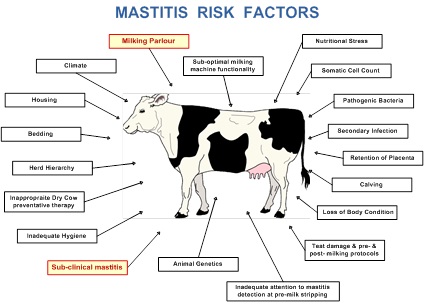
Mastitis remains a major challenge to dairy farmers around the world. It is a disease state that negatively impacts profitability. Numerous risk factors contribute to outbreaks.
These are summarised immediately below:
Foremost among these risk factors is what happens in and around the milking parlour. Mastitis can be contracted from environmental sources, but by far the most troublesome source of infection for milk producers is contagious transmission during milking. Good hygiene practices and correct maintenance and functionality of milking equipment are important in minimising cross-contamination between infected and uninfected cows. However, attention to Milking Order (Healthy animals prior to animals infected by clinical or sub-clinical mastitis) is by far the most effective means to reduce mastitis contamination within the milking herd.
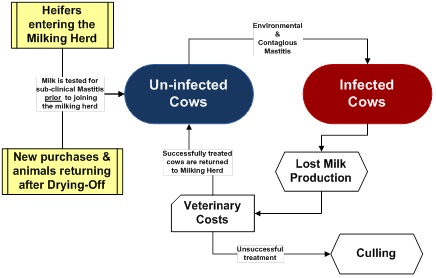
Milk producers spend a significant part of their day cleaning milking equipment after each milking in preparation for the next milking session. These procedures count for nought if animals infected with either clinical or sub-clinical mastitis contaminate milking equipment or gloves / hands early in each milking cycle. A knowledge of Somatic Cells Counts (SCC) for each cow can allow healthy animals to be milked first. SSC reflects well the levels of bacterial infection, but these varying over time. Therefore, regularly monthly Centralised Milk Testing (CMT) can provide invaluable information so as to allow the milk producer to group cows within the milking herd (usually separate lots, pens or fields), i.e. as a consequence of their respective and evolving SSC. In turn, this allows Milking Order to be accurately regulated to the benefit of Herd Health, Milk Quality and Milk Quantity. The latter is impaired significantly whenever one encounters outbreaks of mastitis. Thus, Milking Order is justifiably of paramount importance to the economic viability of dairy farming in Russia and internationally. Unfortunately, Russian milk producers have been slow to implement monthly CMT and have largely ignored the associated economic benefits of CMT as practiced widely elsewhere in the world.
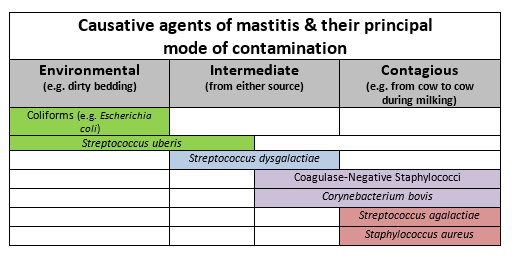
Mastitis can be derived from environmental sources, but by far the most dangerous for milk producers is contagious infection that can spread rapidly to the bulk of animals in the milking herd. Bacterial species involved in mastitis often provide clues as to where and when mastitis has been contracted. Thus, in addition to regular CMT, appropriate intervention and control measures need to be introduced and targeted accordingly. This can only occur once milk producers are aware of exactly what species are producing infection in their herds. Such epidemiological information can then also be supplemented by susceptibility testing in order to advise treating veterinarians as to the most appropriate antibiotic(s) and / or bacteriophage to treat the relevant infectious agents.
Conclusion:
Milking Order can only be optimised in conjunction with regular access to Centralised Milk Testing and thereby accurate information as concerns especially sub-clinical mastitis for each animal in the milking herd. Otherwise, mastitis will spread from cow-to-cow during milking independent of efforts to clean and maintain milking equipment and pre- and post- milking teat cleaning protocols.
In principle, cases of clinical mastitis should not go unnoticed in the milking parlour, i.e. if workers behave conscientiously. However, the question arises: For how long (days or weeks) prior to mastitis detection have animals manifesting sub-clinical infection entered the milking parlour prior to perfectly healthy cows? The latter scenario automatically increases bacterial counts and SCC’s in bulk milk. Importantly, it also serves to highlight the importance of Milking Order and the mechanism whereby mastitis is known to spread from cow to cow and indeed throughout the entire milking herd, namely, through cross-contamination during milking. Once cows are infected sub-clinically, infection can be exacerbated by a multitude of other compounding factors, but most notably, poor body condition due to ketosis and lameness; poor teat condition; and numerous other factors. When the animal’s normal body defences are compromised, mastitis readily takes advantage of the opportunity to the direct detriment of the milk producer. Thus, the long list of associated risk factors as presented above.
It is important to establish the proper Milking Order, so as to not contaminate healthy cows in your herd.
The proper Milking Order is:
1. Healthy Cows
2. New purchases & recently calved heifers
3. Cows having experienced prior episodes of mastitis this milking cycle
4. Cows with chronically high SCC
5. Cows with confirmed sub-clinical or clinical mastitis due to contagious bacterial species
a. Ideally, milked using separate equipment (wherever possible).
Doctor Ian Humphery-Smith,
Lecturer for medical and veterinary students for infectious diseases and molecular biology for 7 years
Founded of the Human Proteome Organisation to take-up the gauntlet of the next phase of the Human Genome Project
Director of International Business Development at the Skolkovo Foundation
Consultant for multinational corporations across Space, IT, Biomedicine and Energy sectors
Presently the Head of private sector investment in Skolkovo RusInnovations
Foremost among these risk factors is what happens in and around the milking parlour. Mastitis can be contracted from environmental sources, but by far the most troublesome source of infection for milk producers is contagious transmission during milking. Good hygiene practices and correct maintenance and functionality of milking equipment are important in minimising cross-contamination between infected and uninfected cows. However, attention to Milking Order (Healthy animals prior to animals infected by clinical or sub-clinical mastitis) is by far the most effective means to reduce mastitis contamination within the milking herd.
Milk producers spend a significant part of their day cleaning milking equipment after each milking in preparation for the next milking session. These procedures count for nought if animals infected with either clinical or sub-clinical mastitis contaminate milking equipment or gloves / hands early in each milking cycle. A knowledge of Somatic Cells Counts (SCC) for each cow can allow healthy animals to be milked first. SSC reflects well the levels of bacterial infection, but these varying over time. Therefore, regularly monthly Centralised Milk Testing (CMT) can provide invaluable information so as to allow the milk producer to group cows within the milking herd (usually separate lots, pens or fields), i.e. as a consequence of their respective and evolving SSC. In turn, this allows Milking Order to be accurately regulated to the benefit of Herd Health, Milk Quality and Milk Quantity. The latter is impaired significantly whenever one encounters outbreaks of mastitis. Thus, Milking Order is justifiably of paramount importance to the economic viability of dairy farming in Russia and internationally. Unfortunately, Russian milk producers have been slow to implement monthly CMT and have largely ignored the associated economic benefits of CMT as practiced widely elsewhere in the world.
Mastitis can be derived from environmental sources, but by far the most dangerous for milk producers is contagious infection that can spread rapidly to the bulk of animals in the milking herd. Bacterial species involved in mastitis often provide clues as to where and when mastitis has been contracted. Thus, in addition to regular CMT, appropriate intervention and control measures need to be introduced and targeted accordingly. This can only occur once milk producers are aware of exactly what species are producing infection in their herds. Such epidemiological information can then also be supplemented by susceptibility testing in order to advise treating veterinarians as to the most appropriate antibiotic(s) and / or bacteriophage to treat the relevant infectious agents.
Conclusion:
Milking Order can only be optimised in conjunction with regular access to Centralised Milk Testing and thereby accurate information as concerns especially sub-clinical mastitis for each animal in the milking herd. Otherwise, mastitis will spread from cow-to-cow during milking independent of efforts to clean and maintain milking equipment and pre- and post- milking teat cleaning protocols.
In principle, cases of clinical mastitis should not go unnoticed in the milking parlour, i.e. if workers behave conscientiously. However, the question arises: For how long (days or weeks) prior to mastitis detection have animals manifesting sub-clinical infection entered the milking parlour prior to perfectly healthy cows? The latter scenario automatically increases bacterial counts and SCC’s in bulk milk. Importantly, it also serves to highlight the importance of Milking Order and the mechanism whereby mastitis is known to spread from cow to cow and indeed throughout the entire milking herd, namely, through cross-contamination during milking. Once cows are infected sub-clinically, infection can be exacerbated by a multitude of other compounding factors, but most notably, poor body condition due to ketosis and lameness; poor teat condition; and numerous other factors. When the animal’s normal body defences are compromised, mastitis readily takes advantage of the opportunity to the direct detriment of the milk producer. Thus, the long list of associated risk factors as presented above.
It is important to establish the proper Milking Order, so as to not contaminate healthy cows in your herd.
The proper Milking Order is:
1. Healthy Cows
2. New purchases & recently calved heifers
3. Cows having experienced prior episodes of mastitis this milking cycle
4. Cows with chronically high SCC
5. Cows with confirmed sub-clinical or clinical mastitis due to contagious bacterial species
a. Ideally, milked using separate equipment (wherever possible).
Doctor Ian Humphery-Smith,
Lecturer for medical and veterinary students for infectious diseases and molecular biology for 7 years
Founded of the Human Proteome Organisation to take-up the gauntlet of the next phase of the Human Genome Project
Director of International Business Development at the Skolkovo Foundation
Consultant for multinational corporations across Space, IT, Biomedicine and Energy sectors
Presently the Head of private sector investment in Skolkovo RusInnovations
Популярные темы

05.06.2026
В России назрела необходимость ввести на официальном уровне рекомендации по питанию. Об этом шла речь на сессии в рамках ПМЭФ-2026 «Особенности национального питания: здоровьесбережение как основа суверенитета».Участники ПМЭФ считают, что если запугать потребителя сладким и жирным, он быстро начнет худеть
Читать полностью

Цитаты дня
