

Top 100 milk processors: when the second will be the first
The development of the processing segment is driven by several key factors, the main ones being: transforming consumer demand, changing product sales channels, fierce competition, and government intervention.
An analysis of the activities of the 100 largest processors allows us to determine the main trends in the development of the Russian dairy industry.
1. The largest multinational players continue to lose their positions, but maintain the level of sales.
The 100 largest dairy companies increased the volume of raw milk processing by 5.33%, or 683 thousand tons, processing 13.5 million tons (86.05% of all commercial milk). At the same time, the TOP 5 grew by only 1.22%. This was due to the fact that the two leaders - Danone and PepsiCo - significantly reduced the volume of milk processing - by 138 thousand tons (-9.57%) and 73.8 thousand tons (-5.3%), respectively. A serious reduction in processing by Danone also caused the company to lose its leadership in the rating. The company, which had been a leader for several years, lost its position to PepsiCo.
The revenue of JSC Danon Russia (the main activity is the production of dairy products) amounted to 86 billion rubles. This is approximately 0.9% lower compared to 2018, taking into account the reorganization that took place at the end of 2018.
The revenue of JSC WBD (main activity is production of milk (except raw) and dairy products) amounted to 100.3 billion rubles, 2% more than in 2018. The difference in the dynamics of revenue and milk processing is most likely due to the development of the high-margin products segment by companies. This makes it possible to reduce strategically the dependence of companies on suppliers, many of which develop or launch their own processing. Against this backdrop, the statement of President of Danone Emmanuel Faber that the company is ‘committed to revolutionizing the way we look at food’ explains why Danone has gone fr om being the world's largest dairy producer to ‘the world's largest food and water producer.’
2. The growth of large national players.
If we do not take into account the negative indicators of PepsiCo and Danone, all the other participants in the rating of TOP 100 have increased the total purchase of raw milk by 1 million tons. At the same time, the top ten Russian producers accounted for almost half of the growth in processing - 435 thousand tons. The largest growth showed the Perm producer Yugovskoy dairy products combine +122 thousand tons, and the cheese producer of the South of Russia Foodland, which picked up the milk of the Voronezh EkoNiva that was "freed" from Danone and WBD - +94 thousand tons, as well as KOMOS GROUP, which overtook Molvest and took third place in the rating - +88 thousand tons. Molvest dropped to fourth place, while increasing the volume of processing by 51 thousand tons.
3. The dynamic development of the regional players.
New players are making their way to the top of the industry, some of which have been around for at least 5 years. Many of these processors are part of vertically integrated holdings and actively use their own raw material base. These companies occupy the niche of traditional dairy products vacated by multinational companies, or squeeze them out of regional markets.
The most striking examples are A7 Agro - agricultural holding from Orenburg region, whose owners - power engineers - "entered" agriculture a few years ago. The dairy plant A7 agro - OMK has become the largest processor in the region, and it develops milk production in Orenburg region and Bashkortostan. Growth in 2019 was 76.9%, 87th place in the rating.
The group of companies Bely Medved (Myasnikovsky dairy plant) is the second raw milk processor in Rostov region, which increased milk processing from 46 thousand tons to 95 thousand tons in 3 years. Growth in 2019 was 73.3%, 40th place in the rating.
Tyumenmoloko (Arsib holding) grew by 68.6% to 43.8 thousand tons of raw milk, despite the fact that in 2018 the company was declared bankrupt by the Federal tax service, which demanded 30 million rubles of unpaid VAT.
In total, 22 companies in the rating showed growth above 20%. Of these, 16 companies are regional players.

4. Overheating of cheese market
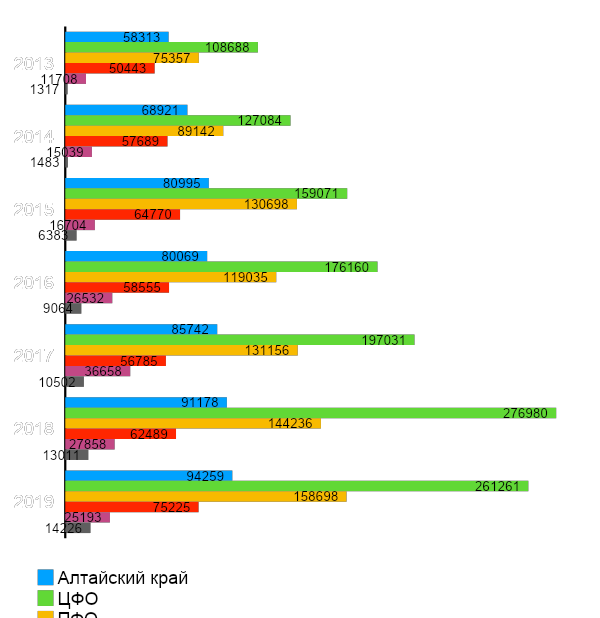
Producers continued to increase cheese production in 2019. As well as cheese products. But in 2018, it became clear that there is more cheese and cheese products on the market than the consumer needs. Especially cheese products. Especially in Western Siberia and Altai region. The Altai cheese region is increasing its production of cheese and cheese products, but they are sold in the European part of Russia, wh ere the growth rate of cheese production is much higher.
As a result, Altai cheese is becoming more and more difficult to sell. The overheating of the cheese market can lead to problems for a number of processors, which, accordingly, will affect the producers of raw milk. It is especially important to note that milk processing has been growing at the expense of cheese in recent years. That is, a reduction in cheese production can cause an excess of milk on the market and a collapse in prices.
A logical but undesirable result may be the transformation of Altai region from a cheese region to a meat one.
In this situation, it is logical to look at the cheese market differently and consider the production of whey (and all derived products) as a priority as a popular raw material on the Russian and global markets, and cheese as a by-product of whey production, which will also allow a different approach to pricing and the economy of milk processing.
5. The growing number of small and medium-sized players is beginning to create competition and problems for large manufacturers.
While the 5 largest companies that processed 20.5% of raw milk in 2019 grew by only 1.2%, the entire dairy industry showed an increase of 3.5%. The growth of raw milk production along with the growth of imports of exchange-traded products increases the density and competition in the dairy market. Today, consumers have a wide selection of dairy products, which is provided not only through retail chains, but also through other sales channels, which are especially actively developing in the context of global disasters in 2020. The development of new sales channels creates opportunities for regional and local players to grow significantly, while it is much more difficult for the largest players to change cumbersome sales systems.
6. Consumer misunderstanding.
With the overall growth of milk processing, many market participants are talking about a drop in demand for milk. This is especially often stated by the largest processors. Analysis of the development of major players suggests the opposite: processing is growing and demand is at least not decreasing. It is redistributed. It is becoming clear that the lowest-income consumer is virtually eliminating dairy products from the diet, replacing them with other sources of fat and protein. The cheapest cheese/cheese product is less likely to find a buyer. On the other hand, cheese as a category turns into a product for pleasure, a delicacy that is more often consumed with wine than with tea. The attitude to drinking milk is changing. Fewer pensioners are buying cheap milk and more young and middle-aged people are using it with coffee. Changes in consumer demand clearly entail a redistribution of players in the dairy market. Companies that have failed to adapt production and marketing to the new requirements of the consumer, and at the same time constantly talking about a drop in consumer demand, will be forced to leave the market, and their place will be taken by more sensitive and mobile ones.
DOWNLOAD THE RATING OF THE TOP 100 LARGEST MILK PROCESSORS.
If you want to support the rating of the TOP 100 largest milk processors on the Russian market, fill in the feedback form below or contact the marketing Department by phone: +7 (495) 660-83-57
The rating was compiled with the support of companies
Kieselmann Rus
Pavlov Company
Enviro-Chemieнвиро-Хеми


Цитаты дня
